Annotated Bibligraphy

Research Question: 

“How colored girls are affected short-term and long-term by generational racism and systematic stigmas.” 

Kuenz, Jane. “The Bluest Eye: Notes on History, Community, and Black Female Subjectivity.” 

African American review 27.3 (1993): 421–431. Web.

Kuenz’s emphasis on the cultural setback in, “The Bluest Eye,” of young black girls through seclusion is her main objective in her article. She further discusses the result of these setbacks, and how it affects the girls as women. Lack of identity is what the author strongly rests on as a major affect to their personal lives, due to the segregation of cultures.

 Rosenberg, Ruth. “Seeds in Hard Ground: Black Girlhood in The Bluest Eye.” Black American 

literature forum 21.4 (1987): 435–445. Web.

Rosenberg writes about the self-image of black girls, especially in childhood, using Mahalia Jackson, Maya Angelou, and Bessie Smith as starting points for her examples. She writes of the experiences of black girls and women clinging to each other because they alone have only experienced the same. Rosenberg also mentions how Morrison’s black girlhood enlightened others to let them know they are not alone. She ends in a scary truth of, “The Bluest Eye,” and how dangerous a designated culture and way of life can be. 


Roye, Susmita. “TONI MORRISON’S DISRUPTED GIRLS AND THEIR DISTURBED 

GIRLHOODS: ‘The Bluest Eye’ and ‘A Mercy.’” Callaloo 35.1 (2012): 212–227. Web.

Roye’s article discusses Morrison’s focus on troubled girls in her writing. She compares the troubles from both, “The Bluest Eye,” and, “A Mercy.” The different stages and types of pity and sadness she gives her female characters through their identity, sexual identity, economic stages, desires, and family play a major role in Morrison’s plot line. The author insists that this is Morrison’s way of attesting to a largely unequal socio-economic and cultural system. Roye’s main objective is to elaborate on Morrison’s vision to expose these inequalities and create assimilation through struggle. 


Vasquez, Sam. “In Her Own Image: Literary and Visual Representations of Girlhood in Toni 

Morrison’s The Bluest Eye and Jamaica Kincaid’s Annie John.” Meridians 12.1 (2014): 58-87. Web.

This critical essay informs readers about the cultural and personal setbacks/experiences of young girls in, “The Bluest Eye”, and  “Annie John.” Within the essay, Vasquez discusses: the theoretical and historical underpinnings of the writers and their personal experiences, visual culture and diverse socio-historical context, impact of western patriarchy, mixed racism, and literary context. The author goes into a deep dive of a black girl’s struggles between both books, and their grapple with Western cultural stigmas.


 Zebialowicz, Palasinski. “Probing Racial Dilemmas in ‘the Bluest Eye’ with the Spyglass of 

Psychology.” Journal of African American studies (New Brunswick, N.J.) 14.2 (2010): 220–233. Web.

This article takes a psychological look on Toni Morrison’s, “The Bluest Eye.” Zebialowicz sets out specific passages to analyze the effects of racism, identity crisis, beauty, white ethnocentrism, and more. She takes a deeper look into not only the feelings narrated but the buried shame, lack of power, and animosity holds within the characters. She tries to unload most of Morrison’s female racial issues and give insight through psychology.


My research process consisted of OneSearch on the hunter database site, and the keywords of: “The Bluest Eye” and stigmas, “” and racism, “” girlhood, “”and psychology. Many searches came up, but from reading through the different options I found these passages relating to my topic the most. These articles and essays hammer in on the type of research I’m looking for, giving me a wide variety of information from different sources and experiences.

Pauline’s Stunted Mindset

Morrison’s portrayal of Pecola’s mother, Pauline, initially stirs hatred and resentment in readers. It’s only until Spring do we find she felt neglected and ugly her entire life and then finally rescued when Cholly approaches her. It’s only after economic trouble does all her sadness come back. She has always  identified with being ugly and only for a small part of her life she doesn’t. This time would be when her and Cholly first got married and were still in love.

“He came, strutting right out of a Kentucky sun on the hottest day of the year. He came big, he came strong, he came with yellow eyes, flaring nostrils, and he came with own music.” (114) 

 Other than that she spent most of her self-reflection based on her color, economic status, home-town, and deformities. She finds pleasure in tidying up and movies, but these only aid to her superficial ideas of love and self-hatred. She always found cleaning and organizing as a personal interest to be liked. I believe because she felt secluded and shoved aside, even in her own family did she try to “fix” things and use that to be accepted. She goes so far to make it her profession and get ahead in life. Her movies also enable what her true definition of love is. Media morphs  Pauline into believing that true love revolves on money and skin-deep beauty, both of which she thinks she does not have much of. It was of these false ideas did she even fall in love with Cholly, for if she truly saw their dysfunction, she would not have considered his, “[firm] but [gentle],”(118) touch so valuable.

In a way, Cholly was her way of escaping her own self-immolation and simultaneously, the same entity to put her right back where she was as a younger girl. Pauline uses the abuse for the power she feels as a victim or a martyr, by “holding Cholly as a model of sin and failure,” (126-27) as she stays with him. She likes to go to church and come home to an abusive husband to accredit herself for being a good person. She never truly grows out of the narratives she created for herself as a child. Narratives with shallow and distorted ideals as its foundations. She uses these to daydream, and recreates them even as an adult. The same desires she had as a child, and never fulfilled, she finds as an adult. When she starts working for a family with money, and clothes, and food does this hunger get slightly fed. Her work then became her life, because it was the only place she had meaning, other than feeling ugly. When she worked she was, “queen of canned vegetables,” with “power, praise, and luxury.” (128) And when her shift ended she went back home to the store-front and the family she in turn neglected, and abused.

Betrayal or Revenge?

Clifton’s dancing paper doll symbolizes the reason why the Invisible Man is telling his story. This occurs in different ways. The IM also feels betrayed by Clifton. After Clifton’s unannounced disappearance and reappearance, IM loses hope in his newly found reason to be. His Brother’s betrayal lies in the doll he’s selling more than anything. IM mentions selling apples or shining shoes instead of being a sellout. I believe there is a justified answer in selling black paper dolls. His anger soon vanishes after watching Clifton be killed. The taunting paper doll represents black men and their journey in history. The flimsiness of the paper and the dance it dances to is a clear delineation to the oppressed life of dark skinned people. Invisible Man - SAMBO

Even if slavery was abolished there still lies a segregation between black and white people. This segregation is the life that the black man must live. He cannot live his own life, with his own thoughts and desires. He has to think and want in secret. In secret and not in front of the white man. He must dance until he is tired. And when he gets tired he must keep dancing. He dances something not of his own but movements he’s forced to do. “A dance that [is] completely detached from the black, mask-like face.” (334) His mind, or in this case his face, is not controlling his actions. The white men, or in this case his puppeteer controls his actions. The way the IM talks about the disconnections between Sambo’s head and body fully symbolizes the oppression of black men in the world. IM’s novel wants to spread the real story, his side of Clifton’s death to readers and not just the narrative white people would have told.

Other symbolism that lies within this chapter and Sambo deal with more oppression. At some point the IM asks himself, “What about those fellows waiting still and silent there on the platform…?”(341) These were the men outside of historical time. The ones that danced and their story never heard. Some even danced without complaint. The Sambo that the IM flung in his pocket symbolized them. They were shook and shook and not broken. As the IM shoved the Sambo, he so wanted to smash with his feet, alike was culture and race muffled in a pocket. Even the physical action of the IM not smashing Sambo, was conformity in it’s finest hour. The IM stopped himself in his tracks and wondered if smashing Sambo was what the white policeman wanted to see. It wasn’t so he didn’t. Both Sambos represent what black people had and have to live with. The harsh reality of fitting within white people’s guidelines of living. 

I do not believe Clifton’s merchandise killed him in vain. Clifton might have disappeared, but raw emotion and yearn for equality don’t dissolve into thin air. Why not sell apples or shine shoes? I believe Clifton’s intentional decision to sell Sambos was revengeful. I do not want to give my oppressors a hardy apple, or nice shiny shoes. I want to mock them for hating me so much that they gave me a meal or bought me clothes. Clifton died fighting and was not selling Sambo’s to make white people happy, but to prove that their cold hatred can hurt them more than it hurt him. Chapters 16-20 - Invisible Man

Writing Characters and Method Acting


Rankin and Loffreda’s Essay, “On Whiteness and the Racial Imaginary” alludes to not only white writers, but also white actors. Or any art for the matter. “The point of view of a character” is exactly what actors must see when they take the role of a character. Over the summer I took an acting class for a couple extra ‘easy’ credits. The main insight I received from it was that acting is not really acting at all. You must actually feel the pain, happiness, confusion, etc…and it has to be real. If you are not feeling what your character is feeling, you must bring it from your own life and expose it on stage. Rank and Loffreda try to tell readers that white people cannot stand on stage and become black for a moment and go back to living in their “whiteness.” 

This is why actors dive deep into method acting. The authors hint at this aspect in their essay while discussing the ‘research’ white writers do to write a black role. Method acting can be very intense and very beneficial for empathizing. Actors have even joined the army for an army role. This sounds like what white writers try to do when they “meet race and [travel] to Africa…” To know of injustice is not to feel it. Their ‘method acting’ for their work just simply cannot serve what they would like it to.  The research that would suffice to take on a black character as a white writer would need a time machine. To write about knowledge is not good enough. For white writers to method act themselves into their black characters they would need to relive (or in fact live) the racism, prejudice, discrimination, and injustice. The equal type of treatment could never be empathized for. It’s impossible, and the world in which it can is referred to as a “utopia.” Rankin and Loffreda’s utopia in their essay is summed up by a world that does not acknowledge race. In another world you acknowledge all races and be able to “transcend” into another race, which again is a utopia. In this utopia, where all transcendence is accessible Rankin and Loffreda’s question would remain. Why are you doing this? What is coming from it? If white writers were to actually step into the shoes of black characters their reason would change. White writers or actors posing as black for a temporary amount of time have the luxury of going home and not having to live that role. Black people cannot do the same, and this is the stigma the authors discuss. This stigma lies in acting as well. Black people are limited to black roles, while white actors get cast minority roles. The character role and writing of a character hold the same criteria in Rankin and Loffreda’s essay.


Fanon’s Identity

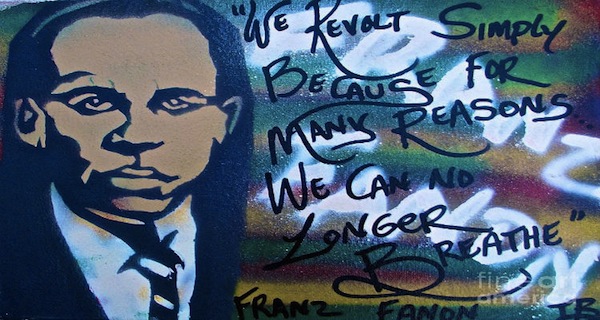
“I was an object in the midst of other objects” Frantz Fanon writes to try to understand who he is among the world. He, being treated like a thing due to his blackness, is amid other black people being treated the same. And these humans reduced down to objects were curtailed by white people. This chapter represents Fanon’s renovation of his own identity, as the others (the white man) have already constructed it. Even as they identify him using racial slurs he pushes away acceptance of it, after being beaten down time and time again. With every time he tries to rationalize a way of proving his pride and identity in being black, he fails to come to an adequate conclusion. Instead, he does not want to have to prove his worth but live as who he is. Fanon illustrates the fact of being black. 

Fanon’s sense of identity is introduced within the first line of the chapter; it is what he has been labeled his whole life and limited to. Another sense of a black man’s identity is mentioned shortly after, in the next paragraph. “For not only must the black man be black; he must be black in relation to the white man.” (257) This is a pivotal point in the lack of identity Fanon faces. Being a black man is not the reason he confronts racism and segregation his entire life. He is confused and uncertain about who he is and how he is valued, only when compared to the others that make him feel this way. If it were not for them, he could understand himself as an intelligent black man, and not a “savage, brute or illiterate.” (261) 

His sense of identity is challenged again when his consciousness comes into play. The world in which he has a “third-person consciousness” and “uncertain certainty” (258) is the world that he has a black man lives and the world that has classified that being a black man is an atrocious thing. Because of this the ‘corporeal scheme’ is no use, for it’s been taken over by a racial scheme that runs his world. His identity is taken over by children. He is the scary black man, who might eat a child up. He becomes a monster and a life lived like this sets a continuous unsteady sense of self. 

MR Online | A revolutionary lifeline: teaching Fanon in a postcolonial world