Colored

The writers, Zora Neale Hurston and Frantz Fanon, describe the consciousness of the black subject in a world of white power. They both shared information about racial barriers with sympathetic readers who wish to tolerate differences. For Hurston recounted her experience as a black woman in her essay “How it feels to be colored me.” She came from a completely isolated community of color, which makes her unable to understand that not everyone in the world is treated the same. At the age of her thirteenth she gradually became aware of her color as “It is exclusively a colored town” (1928). But she tried to accept her identity, not her black complexion. According to Hurston she thought that being black will not have any influence on her as “BUT I AM NOT tragically colored […] do not mind at all.” She believed that this world is suitable for people who have strong abilities, embrace their lives and value their skin colors. She even believed that race is not a basic characteristic that people are born with but appears in a specific social environment. Hurston included that she didn’t have time to sad about her blackness as “No, I do not weep at the world- I am too busy sharpening my oyster knife.” She meant that she was so busy in pursuing her happiness and positive life.

For Fanon also related to his experience of being black in his essay “The fact of blackness.” He mentioned at the beginning of the essay as “I turned beseechingly to others. Their attention was liberation, running over my body suddenly abraded into nonbeing” which showed the statement of his nonexistence because of the environmental discrimination. He argued that black have experienced as their beings were seen by others instead of themselves. Fanon desires is to discover his own identity, strength and existence, so as to become his true identity. According to Fanon, “I sit down at the fire and I become aware of my uniform. I had not seen it. It is indeed ugly. I stop there, for who can tell me what beauty is.” He is desperately trying to find some framework to understand himself. All he has to do is to become a person who belongs to the world and can help the whole person as he grows. As the critical examination of Farnon is the psychological influence of racism, especially the influence of colonial subjects. However, Hurston analyzed for deep-rooted colorism and quality skin in the African American community. Everything she proved to be white power and repression of blacks.

Although these two authors are talking about the racism for people with colored, but I can feel empathy to the characters’ feeling. When I first came to the US, I know that I have to start living in a diverse society with different color of people, but I didn’t think any more about it and even forget about the racial different. But now, as the COVID-19 occurs, I am started aware of how society views on my race as Asian especially Chinese. In the article, Hurston perfectly states about the complex sense and feeling of individual when people become aware of their race. Instead of people are fighting against each other based on their skin color or race, should unite together and fight against all difficulties including the pandemic.

Fanon’s Identity

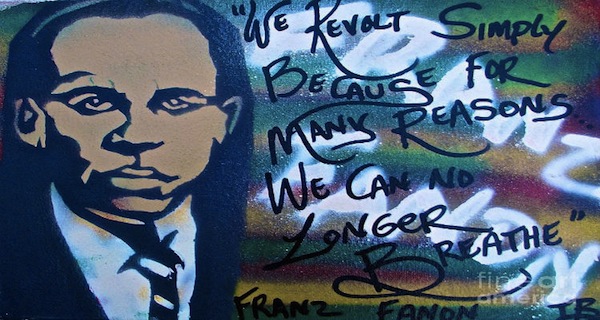
“I was an object in the midst of other objects” Frantz Fanon writes to try to understand who he is among the world. He, being treated like a thing due to his blackness, is amid other black people being treated the same. And these humans reduced down to objects were curtailed by white people. This chapter represents Fanon’s renovation of his own identity, as the others (the white man) have already constructed it. Even as they identify him using racial slurs he pushes away acceptance of it, after being beaten down time and time again. With every time he tries to rationalize a way of proving his pride and identity in being black, he fails to come to an adequate conclusion. Instead, he does not want to have to prove his worth but live as who he is. Fanon illustrates the fact of being black. 

Fanon’s sense of identity is introduced within the first line of the chapter; it is what he has been labeled his whole life and limited to. Another sense of a black man’s identity is mentioned shortly after, in the next paragraph. “For not only must the black man be black; he must be black in relation to the white man.” (257) This is a pivotal point in the lack of identity Fanon faces. Being a black man is not the reason he confronts racism and segregation his entire life. He is confused and uncertain about who he is and how he is valued, only when compared to the others that make him feel this way. If it were not for them, he could understand himself as an intelligent black man, and not a “savage, brute or illiterate.” (261) 

His sense of identity is challenged again when his consciousness comes into play. The world in which he has a “third-person consciousness” and “uncertain certainty” (258) is the world that he has a black man lives and the world that has classified that being a black man is an atrocious thing. Because of this the ‘corporeal scheme’ is no use, for it’s been taken over by a racial scheme that runs his world. His identity is taken over by children. He is the scary black man, who might eat a child up. He becomes a monster and a life lived like this sets a continuous unsteady sense of self. 

MR Online | A revolutionary lifeline: teaching Fanon in a postcolonial world

I Was Born

            In at least two of the essays we’ve read so far, the authors have annotated the first time in their lives when they realized they were different, or that they were “Other” than what was widely acceptable. These essays include “The Souls of Black Folk,” by W.E.B. Dubois, and “The Fact of Blackness,” by Frantz Fanon. Similar to the slave narrative literary device of writing “I was born…” at the beginning of each narrative, these moments attempt (and succeed) in humanizing the authors and in turn the subject of the black body. All humans have a beginning, all of them are born from a family, all of them have values, and have the sense of self that the word “I” entails. DuBois and Fanon describe their state of consciousness before they came to the realization of their “otherness,” in pan-palatable ways, so that there is a lack of racial “inscription” they write upon themselves; in other words, they write themselves as the “every-person” for whom race isn’t a discriminating entity in their lives, up until a certain point.

         Fanon writes of a harsh realization of his otherness when he looked at himself through the eyes of Caucasians. “The black man among his own in the twentieth century does not know at what moment his inferiority comes into being through the other…Together we protested, we asserted the equality of all men in the world… And then the occasion arose when I had to meet the white man’s eyes… The real world challenged my claims.” (Fanon) Although having fought for equality implies inequality, realizing his otherness came about later in life, when the world would “challenge” his claims of sameness. It represents a turning point in the way Fanon saw himself as a objectified in the Caucasian Western gaze. It implies that racism is a construct, a man-made ideology used to subjugate and partition people, and that otherness is not a natural phenomena (within humankind). If it were natural, it would not have to be taught or realized – there would be no need for a cognitive shift.

           On the part of DuBois, he dictates his first encounter with otherness when he was a young boy interacting with a young Caucasian girl his age who refuses to accept a card he made because of his skin color.  “It is in the early days of rollicking boyhood that the revelation first burst upon me, all in a day… The exchange was merry, till one girl, a tall newcomer, refused my card…Then it dawned upon me with a certain suddenness that I was different from the others…” (DuBois) Before it “dawned” upon DuBois that he was different, he describes a typical “boyhood” and innocence. Similar to Canon’s account, a first-hand reality check began the fermentation process of otherness and separation from “good”.

           We’ve seen delicate and careful rhetoric in both W.E.B. DuBois’ “The Souls of Black Folk” and Frantz Fanon’s “The Fact of Blackness” in which both authors write on their first experience of racism; or awareness of their “blackness”. These accounts conclude that racism is unnatural and that every human being is inherently and irrevocably the same.

Reflections

In his essay Nature, Ralph Waldo Emerson describes how humans have lost contact with nature and the importance of reconnecting with it in order to better understand themselves. Throughout the piece, he draws on transcendentalist ideology to prove his point, emphasizing the divine aspects of nature that “few adult persons” can see. Furthermore, he stresses the failure of science to identify a “theory of nature” and says that past attempts to do so have only resulted in further division and hatred amongst the human population. The crux of his argument is the idea that by immersing himself in nature, he is able to transcend  “mean egotism”, shedding societal values, preconceived notions, desires, identity, gender, race, nationality, and class in order to become one with nature. He takes the form of a “transparent eye-ball” and is able to see and understand all without being seen. He is above racial, religious, and other man-made distinctions.

Whereas Emerson is empowered by sight when he becomes a “transparent eye-ball”, many African American writers from this period and afterward seem to be burdened by sight — both in the ways that they are seen by other (especially white) people and in the ways they have started to view themselves as a result. They are seen as “object[s]” (Fanon, 257), as savages (Fanon, 261), as intellectually inferior (DuBois), or as pitiable (Hurston). Many of them describe the weight of having to exist on two or three different planes, of existing both as their true selves and as a black person in a racist society. Despite differences in the ways they describe and think about this issue, discrimination does contribute to the sense that they are being held back from reaching their fullest potential. In Fanon’s words “I am a master and I am advised to adopt the humility of the cripple (265), or, as Hurston sarcastically puts it, “It is thrilling to think–to know that for any act of mine, I shall get twice as much praise or twice as much blame. It is quite exciting to hold the center of the national stage, with the spectators not knowing whether to laugh or to weep.” (Hurston) Moreover, they are hurt by the internalization of these messages by themselves and by other black people. Fanon describes being rejected by other black people as they make efforts to assimilate or even become white, not wanting their efforts to be tainted by him. Even Hurston, who claims to “have no separate feeling about being an American citizen and colored” admits to feeling the effects of discrimination and of being seen as a race before being seen as an individual.

For these authors, empowerment then is found not in seeing, but in learning to unsee themselves in the narrative that has been forced upon them as black Americans. For DuBois and Fanon, that means discussing the limitations that have been systematically placed on black people and actively working to counteract them. For Hurston, it means shedding race entirely and refusing what she perceives to be sympathy over the slavery that her ancestors endured. However, for all of them, it means persevering, being successful, and proving racist Americans wrong through their success.

Emerson’s ability to become a “translucent eyeball”, despite his insistence that doing so extinguishes such distinctions as “master [and] servant”, is an ability largely and unwittingly based in his own privilege. It’s not that these types of experiences are inherently exclusive, but that it is easier for Emerson to shed his identity and ignore the tensions surrounding race relations in the United States as a person who is not only exempt from racial discrimination but benefits from it. Whereas Emerson and Hurston (in different ways) seem ready to move past the issue of race in the United States, for many people, such as Fanon and Dubois, examining race is key to achieving the type of understanding that Emerson seems to be seeking.

Objectification and Vision According to Hurston and Fanon

At the conclusion of “How it Feels to be Colored Me,” Zora Neale Hurston leaves readers with a striking analogy. She imagines herself as a brown paper bag with various objects inside that represent aspects of her identity. Curiously, Hurston calls the objects both “priceless and worthless.” On the one hand, they bear some meaning to her because they represent different periods from her unique life experience: a key presumably from a house she once lived in, shoes representing the hope for a journey she never embarked on, and so on. On the other hand, they are worthless because they are mundane items. Although they have sentimental value, they have no monetary value.

According to Hurston, these objects are also somewhat unimportant because they bear much resemblance to the common objects that we all collect, regardless of our skin colors. She sees those around her to be like differently colored paper bags representing their different skin colors. Through claiming that the contents of each bag, if emptied, would be more similar than different, Hurston asserts that we are more alike than different on the inside. In her text, she uses objects to represent commonalities. Perhaps Hurston is trying to put forth a positive vision for the future. In a way, the objects we collect represent what we value in the world. If we all took time to explore the things we value, perhaps we would be able to more easily bridge our perceived differences.

In contrast, Fanon views objects as vectors of hatred in “The Fact of Blackness.” He describes himself as being “sealed into that crushing objecthood (257).” By this, Fanon means that the white people around him have reduced him to just “a Negro,” a caricature and a vessel for their stereotypes rather than a dynamic and complete person. Instead of seeing that he is well-read and shivers in the cold like any human being, others assume he is angry and cannibalistic. Fanon claims that “the Negro is a toy in the white man’s hands (265),” as he is shaped into what the white man wants him to be at a particular moment and only seems to exist for the white man’s amusement.

Fanon’s despair and frustration are evident throughout this work, and the ending of the passage is no different. Although he asserts his inner strength and refusal to have his personhood reduced, he is overwhelmed by his struggles. Like Hurston regarding the worth of objects, Fanon also mentions a dichotomy: that between “Nothingness and Infinity (265).” He is aware that his potential and the potential for greater empowerment of blacks is infinite, but aggressors still work to reduce him to nothingness. Hurston sees value in examining our most treasured objects, whereas Fanon wishes that we would avoid framing ourselves and others as simplistic objects. Each vision lends valuable insight into the current black experience and sets forth compelling hopes for the future.