Annotated Bibliography

(Research question: How does Morrison portray blackness and sex as two things that directly and/or indirectly affect one another?)

  • Abdullahi, Jumoke “Jay,” and Kym Oliver. “Triple Cripples: On Blackness, Sexuality, Disability, and Autonomy.” AAIHS, 17 Mar. 2020, https://www.aaihs.org/triple-cripples-on-blackness-sexuality-disability-and-autonomy/.
    • Unlike a few of my sources that focus on blackness and sexuality specifically in The Bluest Eye, this source focuses on blackness and sexuality in the present day and how they relate to each other. However, this source also ties in the topic of disability and its relations to blackness and sex, which is particularly unique because of how it can relate to Polly’s race and sexuality. This source also puts a slight emphasis on religion as well, which can further tie into Polly’s character because of how religious she became due to her poor relationship with sex that stemmed from her insecurity of being abused, black, and disabled.
  • A.R. Gayathri, et al. “Objectification of African American Women in the Bluest Eye.” International Journal of Pure and Applied Mathematics, vol. 119, no. 12, 2018, pp. 2769–77.
    • This article focuses on the direct relationship between blackness and sex by discussing the different types of objectifications that all the female characters in The Bluest Eye are subjected to. It then explains how this affects the characters by creating a sense of self-objectification. Thus, this text argues that Morrison’s portrayal of sexual objectification of black women leads to their lower self-esteem pertaining to their identity as African Americans.
  • Byerman, Keith E. “INTENSE BEHAVIORS: THE USE OF THE GROTESQUE IN ‘THE BLUEST EYE AND EVA’S MAN.’” CLA Journal, vol. 25, no. 4, 1982, pp. 447–57.
    • Byerman makes the argument of how Morrison portrays blackness and sex as two things that are both “grotesque” to the audience. However, he states that this “grotesqueness” is not something that arrives from just racism and the sexualization black men and women, because our society already knows about racism – this is just not shocking enough to the audience because we already know of these problems. Hence, Morrison needs to use topics such as incest to make this novel truly “grotesque” in order to portray the relationship between blackness and sex. 
  • Rosenberg, Ruth. “Seeds in Hard Ground: Black Girlhood in The Bluest Eye.” Black American Literature Forum, vol. 21, no. 4, 1987, pp. 435–45. JSTOR, doi:10.2307/2904114.
    • Rosenberg focuses on the levels of sexualization compared to the levels of blackness by focusing on colorism. She suggests that Morrison is able to focus on the relationship between blackness and sex by being one of the first authors to focus on how colorism, or in other words, light-skinned versus darker-skinned African Americans, and how it affects the treatment of different “types” of black people. Thus, Roseberg argues that there  appears to be a direct relationship between the type of blackness and sex.
  • Rosenthal, Lisa, and Marci Lobel. “Stereotypes of Black American Women Related to Sexuality and Motherhood.” Psychology of Women Quarterly, vol. 40, no. 3, Sept. 2016, pp. 414–27. PubMed Central, doi:10.1177/0361684315627459.
    • This source is a research experiment done with the purpose of finding out how prevalent stereotypes of African American women are related to sexuality and motherhood in comparison to white women. It was found that many stereotypes remain alive in the present day and that they have extremely detrimental effects on black women. This experiment is therefore useful to my research question because it actually analyzes the relationship between blackness and sex by using the scientific method. The findings can then be compared to the way black women are treated throughout The Bluest Eye in terms of how the research correlates with the relationship between blackness and sex portrayed in the novel.
  • “Sex Stereotypes of African Americans Have Long History.” NPR.Org, https://www.npr.org/templates/story/story.php?storyId=10057104. Accessed 30 Nov. 2020.
    • Professors Herbert Samuels and Mireille Miller-Young discuss the sexual stereotypes, particularly honing in on black sex workers. They discuss how there is a direct relationship between blackness and sex based on how they are paid, how black sex workers are viewed compared to white sex workers, and even how these things are impacted by politics. However, what is most relatable to The Bluest Eye is how the professors discuss how black communities often disidentify with sexuality as a whole. This can relate to the sex workers in the novel and others’ attitudes towards them. (For example, Claudia’s mother despises them simply because they make a living off of sex, which can perhaps be interpreted as disidentifying with sex.) Thus, this source touches upon a more specific relationship pertaining to sex and blackness.
In Memory of Trayvon Martin(s)

The fifth situation from Section VI of Claudia Rankine’s Citizen is dedicated specifically to the memory of Trayvon Martin. The very basic definition of “situation” is “a set of circumstances in which one finds oneself; a state of affairs.” The reason why Rankine calls these texts “situations” is because of how she writes about her subjects. What they go through is not, by any means, their fault. Rather, they are thrown into these circumstances that are beyond their control simply because of the racism and profiling they face because they are black. It is clear that the main character of this particular situation, Trayvon Martin, therefore “found himself” in the circumstances that ultimately ended with his death. 


However, the text could (unfortunately) also apply to many other black men who were unjustly discriminated upon, as she calls upon her “brothers” from the many eras America has gone through, ranging from “the years of passage, plantation, migration, of Jim Crow segregation, of poverty, inner cities, profiling” – all eras where black men have suffered, both physically and mentally, through the same racism that Trayvon Martin faced. This shows that racism has not changed even as the times did. Rankine depicts how black boys learn about the differences in treatment that they will face through her film. Throughout the entire video, a black man is staring out the window of a moving car and is watching what is going on outside. When Rankine talks about the childhood of a black boy in the beginning, she refers to it as “steep steps into a collapsing mind,” as the black man watches a seemingly happy childhood play out in front of him, where a black boy, perhaps himself, is playing on the beach with his father. This implies that the naive bliss this black boy is feeling is about to go away soon, as he descends down the steps of what Rankine calls a “collapsing mind.” This gives a strong visual of how the black mind is, essentially, broken over time.


This brokenness is slowly beginning to show as the black man’s views out his window quickly change and he now finds himself looking at scenes like police brutality, Malcolm X, and a noose hanging from a tree. This is a stark difference from when he was looking at a boy living a happy childhood. Now, the audience can assume that this boy has grown older and is now becoming more aware of his skin color and how he is treated differently and unfairly because of it. In other words, his mind is slowly starting to collapse, as Rankine had put it. 

The text “reads” differently when viewing it as a film rather than reading it as just a book. When I first read Rankine’s passage, it did not really make sense to me. However, the scene I mentioned is what brought her message together. The video combined with the text allows the audience to literally see what is going on from the point of view of a black man. The audience is directly able to see this walk from point A, where a black boy is innocent and happy, to point B, where he grows up and witnesses acts of racism that forces him to quickly learn the injustices that come with being black. I was able to see someone grow up and watch racism through someone else’s perspective – from Trayvon Martin’s perspective.

Meeting Rankine on Zoom

Hearing Claudia Rankine talk was a lot more inspirational than I thought it would be – not that the topic of her novel is not inspirational, but I ended up learning a lot about Rankine herself and general life lessons that could really apply to anyone in any field, especially through the host’s anecdote about Rankine and the Q&A that followed Rankine’s reading of her novel. The host started off with an anecdote of how she met Rankine. At the time, the host was a small, aspiring poet. When she met Rankine, the host talked about how nervous she was about an upcoming speech she had to give the next day. Rankine immediately took her to her home and sat the host down and made her present in front of her and her husband, almost against the host’s will. I thought it spoke a lot to Rankine’s character – she truly finds the good in people who see the good in her, and will help anyone succeed in whatever way she can.

The reading Rankine presented has already been described in others’ posts, so I’ll be focusing on what Rankine said during the Q&A, which is what stood out to me the most, anyways. One person asked her how Rankine holds her ground as a black woman in a predominantly very white field, and how she reacts when her work is compared to these white standards. Rankine followed with an anecdote of how one publisher called her a few months ago asking for new poems to publish. When Rankine sent them, the publisher called her and said that the poems were awful. A few months later, however, she received a call back from the same person who said that he had found the poems again and absolutely loved them and did not know why he had hated them initially. The moral of her story was that your work is usually judged on the spot by critics. These judgements should not be taken personally, and you should hold your ground when it comes to criticism because if you give up in the face of harsh criticism, you will never find success in such a tough community.

Another answer that I found interesting was the way she wrote her discussed novel. Rankine described these novels as “conversations” between herself and the people who provided her with the anecdotes. She was able to take anecdotes from her peers and reconstruct them so that the text came across as a story that a friend would tell you in a coffeeshop. I thought this was an interesting way to look at it, considering that Citizen was also formatted in this way. Ever since she mentioned it, I went back to the book to reread some passages, and I now read her text more as a conversation between myself and Rankine, as if Rankine is telling me all these experiences that happened to her and her friends.

Rankine is truly an incredibly intelligent, graceful and super cool woman.

simple bibliography

  • Butler-Evans, Elliott. Race, Gender, and Desire: Narrative Strategies in the Fiction of Toni Cade Bambara, Toni Morrison, and Alice Walker. Temple University Press, 1989.

  • Byerman, Keith E. “INTENSE BEHAVIORS: THE USE OF THE GROTESQUE IN ‘THE BLUEST EYE AND EVA’S MAN.’” CLA Journal, vol. 25, no. 4, 1982, pp. 447–57.

  • Rosenberg, Ruth. “Seeds in Hard Ground: Black Girlhood in The Bluest Eye.” Black American Literature Forum, vol. 21, no. 4, 1987, pp. 435–45. JSTOR, doi:10.2307/2904114.

  • Sova, Dawn B. Literature Suppressed on Sexual Grounds. Facts on File, 1998.

  • Thistlethwaite, Susan Brooks. Sex, Race, and God: Christian Feminism in Black and White. Crossroad, 1989.

Is Jim Crow Really Dead?

The first image of the novel depicts a fairly modern neighborhood – the relative modernity of it is proven by the car in the driveway that we see around our own neighborhoods everyday. However, a small street sign is the actual focus of the image, as it reads “JIM CROW RD,” which is a shocking reminder of the racial segregation that was enforced in the southern United States as early as the 1880’s and was abolished in the 1960’s. One of the many things it prevented black people from doing was attending the same schools as white children in the name of “separate but equal.” However, as many knew then and as all of us (hopefully) know now, Jim Crow promoted nothing but separateness and inequality; its mantra simply gave racism a polite front. Thus, this picture was clearly taken years after the Jim Crow laws were abolished as can be seen by the new model of the car in the driveway, and it can furthermore be inferred that this neighborhood is a majority-white neighborhood due to the lingering taste of Jim Crow/anti-blackness still present near people’s homes.

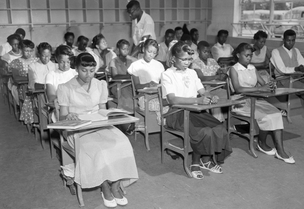
This image is displayed right after the story of the narrator, one of the few black girls in her class, in a predominantly white classroom. Therefore, we can infer that this event takes place in a post Jim Crow era due to both black and white children present in the same class. However, the lingering effects of Jim Crow that are present in the post Jim Crow neighborhood in the photograph also linger in the classroom, as a white girl tries to compliment the narrator by saying she has “features more like a white person.” Clearly, this white girl thinks of blackness as an insult and whiteness as complimentary compared to this “ugliness.” Her comment is her way of thanking the narrator; it may even be her way of trying to explain to both herself and the narrator that her white features are the reason why the narrator is deemed to be “smart enough” to cheat off of. Had the narrator been any blacker, perhaps she would not have been deemed as intelligent enough in comparison to the white girl, even though it was the white girl who needed the help of her black peer. Thus, we can see that both the picture and the story take place in a society that is technically and lawfully post-segregated – but the divide between white people and black people still remains through racism, which the image illustrates. 

Picture

The picture and the text both go hand in hand to explain each other through the concept of, “yes, racism exists even though slavery has been abolished and even though segregation is technically illegal now.” As stated before, the picture shows that Jim Crow still lives on in modern day society. The text can conversely be thought of as a caption for this picture by providing a clear example to describe this image of how exactly Jim Crow’s laws still manage to survive years after they have been outlawed. The story captions the photo by explaining how although white girls and black girls can now learn in the same classroom, black girls are still not immune to the much broader concept of the racially discriminatory mindset behind Jim Crow, just as how the white neighborhood technically allows for black people to live in this community because racial residential segregation is now illegal, but that black people can slyly be kept away by white people keeping “Jim Crow Road” as a passive aggressive threat – a name that could be changed very easily with the support of these white residents. The story has the ability to support the photo as a caption by showing the mindset of why white people still want to keep black people out of their neighborhoods: people will still consider blackness as ugly as they had during the Jim Crow era, or as a trait that makes black people inherently less intelligent compared to their white counterparts, which, in turn, makes them unwanted neighbors in a white society. 

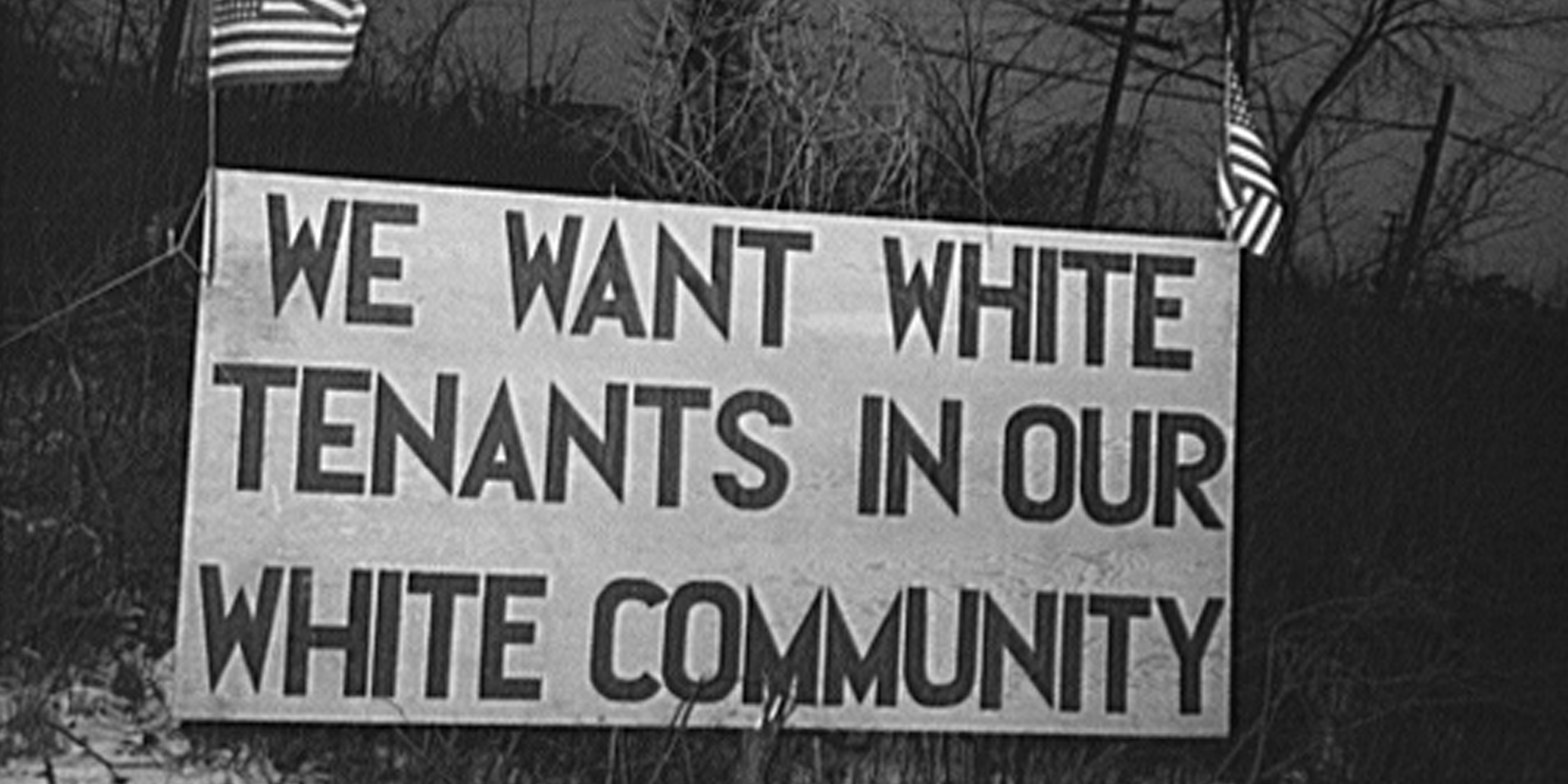
Attacking the Black–White Opportunity Gap That Comes from Residential  Segregation

It can now be seen why Rankine puts such emphasis on the visual in a book that labels itself as a “lyric.” As stated in the lecture, lyrics typically offer an escape from narrative and help to heighten, condense, and intensify the experience. It is almost as if the photo itself is a lyric, based on the ways it is able to do exactly what a lyric does. The image of Jim Crow Road offers a form of escape by showing what is, at surface level, a picture that seems to be completely different from the actual text itself. After all, at first glance, a story about the narrator’s experience in school is vastly different from an image of a pristine neighborhood. However, once the photograph can be related to the text through analysis, the image is able to “heighten, condense, and intensify the experience” – just like a lyric. This specific image is able to condense the text by contextualizing the narrator’s experience into the Jim Crow era. Relating a post-Jim Crow era experience to the Jim Crow laws themselves helps to intensify and heighten the narrator’s experience to the audience because it emphasizes how racism has not changed despite the abolition of these laws. Therefore, Rankine’s images and their lyrical attributes can be a part of the reason why her book labels itself as a “lyric.”
