“I am large, I contain multitudes”

I can’t help but think of Walt Whitman’s “Song of Myself, 51” when reading Hurston’s “How It Feels to be Colored Me”. There is a level of self-awareness that is not only profound, but assertive. Another piece that comes to mind is “Do Not Stand at My Gave and Weep”, by Mary Elizabeth Frye. What these three pieces have in common is their absolute certainty of self. There is no hesitation, no bargaining. Every author is adamant about their identity and refuses to budge. What that means for Hurston is not giving up her sense of self to a label. While she recognizes that it is an inherent part of her, she will not simplify her identity to being “just black”. Hurston is “a brown bag of miscellany propped against a wall”, full of “a jumble of small, things priceless and worthless” (Hurston). In fact, we all are, according to her. 

Despite her rejection of the label, Hurston is not actively denying her blackness. She embraces it. But embracing it for her means something entirely different than it does for another author like Du Bois. 

No, I do not weep at the world–I am too busy sharpening my oyster knife.” 

Hurston recognizes the strides that society has made before, and in, her time. She does not lament over the cruel past, but rather uses it as a starting ground for her progress. Whether that progress is personal, or that of her generation, she doesn’t specify. But she’s using it to her advantage nonetheless. There has never been “a greater chance for glory” in her mind, because there’s nothing to lose. When you start at the bottom, you can only progress upwards. She will use her blackness as both a springboard and tool to achieve greatness. 

The assertiveness of her complexity, as previously stated, heavily resonates with “Song of Myself 51”. In it, Whitman acknowledges that parts of himself might contradict one another, but that’s okay. It’s just who he is, and he will not change that. If the “miscellany”, as Hurston calls it, that makes him up doesn’t make sense, it’s just as well. Hurston speaks in a similar vein. Again, she is not separating herself from her blackness, but is determined to let us know that it is not the only thing that makes her up. From the little girl in Eatonville to “the cosmic Zora”, she too, contains multitudes. 

As a queer person, all this resonates with me. Often you forget you are othered, that you are different. You very much view yourself as “a brown bag of miscellany propped against a wall”. You are the sum of your parts rather than one piece at a time. But at the same time, when you are aware of how society views you, you’re determined to use it to your advantage. Hurston perfectly captures the feeling of having a complex sense of self as an oppressed individual. Often quoted in the queer community is Frye’s poem, usually in the context of former states of identity.  

Do not stand at my grave and cry;
I am not there. I did not die.” 

Similar to Hurston’s experience, we are not denying who we were or are. We recognize the disconnect from those parts of ourselves but embrace it all the same, because it’s a part of our “multitudes”. We did not die when we came into ourselves. We have always been who we are. We may get lost in the intricacies of identity, but that should not erase our complexity. And, in Hurston’s words, “When covered by the waters, I am; and the ebb but reveals me again.”.

Walt Whitman Song of Myself 51

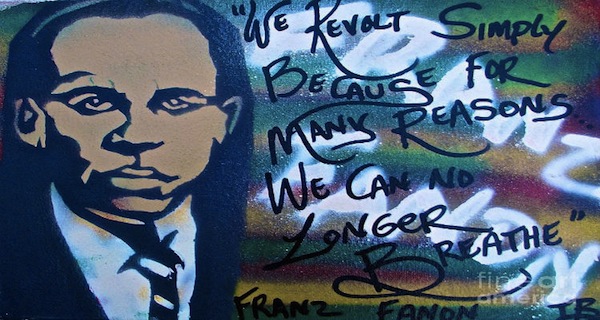
Fanon’s Identity

“I was an object in the midst of other objects” Frantz Fanon writes to try to understand who he is among the world. He, being treated like a thing due to his blackness, is amid other black people being treated the same. And these humans reduced down to objects were curtailed by white people. This chapter represents Fanon’s renovation of his own identity, as the others (the white man) have already constructed it. Even as they identify him using racial slurs he pushes away acceptance of it, after being beaten down time and time again. With every time he tries to rationalize a way of proving his pride and identity in being black, he fails to come to an adequate conclusion. Instead, he does not want to have to prove his worth but live as who he is. Fanon illustrates the fact of being black. 

Fanon’s sense of identity is introduced within the first line of the chapter; it is what he has been labeled his whole life and limited to. Another sense of a black man’s identity is mentioned shortly after, in the next paragraph. “For not only must the black man be black; he must be black in relation to the white man.” (257) This is a pivotal point in the lack of identity Fanon faces. Being a black man is not the reason he confronts racism and segregation his entire life. He is confused and uncertain about who he is and how he is valued, only when compared to the others that make him feel this way. If it were not for them, he could understand himself as an intelligent black man, and not a “savage, brute or illiterate.” (261) 

His sense of identity is challenged again when his consciousness comes into play. The world in which he has a “third-person consciousness” and “uncertain certainty” (258) is the world that he has a black man lives and the world that has classified that being a black man is an atrocious thing. Because of this the ‘corporeal scheme’ is no use, for it’s been taken over by a racial scheme that runs his world. His identity is taken over by children. He is the scary black man, who might eat a child up. He becomes a monster and a life lived like this sets a continuous unsteady sense of self. 

MR Online | A revolutionary lifeline: teaching Fanon in a postcolonial world

How It Feels To Be Colored

Hurston  was a little biracial girl from the small Negro town of Eatwonville in Florida. This was a predominately colored community . Hurston at the age of  thirteen became woke to the fact that she was colored.Living  in a mostly colored community she was seen  as the feminine beauty. Also known as the Zora , she was praised . Hurston was unaware of the impact the color of her skin would have on her.She  was sent to a school in Jacksonville where she was no longer the zora of the community. Hurston was no longer seen for her beauty,but only for the color of her skin.

This was a strange phenomenon for Hurston, yet at the same time symbolized her rebirth. As she states ” She was no longer  Zora of Orange County anymore, and it was evident in the way people treated her. As her  heart beat to the flow of Jazz and the rhythm of the drums she could only face her truth (para four).”

Hurston saw slavery as a priced to pay for civilization. She did not believed her past ancestral trauma defined her.In Hurston eyes that was the past and the present was more important. She never saw herself as the colored girl because that was only someones else interpretation of her.

Zora was who she was and what she would remain. She lived her life in the moment and saw the world as her oyster . Never to be angry or carrying  the hate of her ancestors in her heart. She made the best of being colored and white.

A similarity in Emerson’s “Nature” where he also believes in making the best of the present. The past is only a guide to the development of civilization.  Instead of creating rules to follow its more liberating to let nature take its course.  When a man is open to his surroundings he then experiences a newness in self. Emerson was detached from is ego and saw himself in a higher form. Hurston seem have had the same belief.

Too often do we see this generation of young black men and women attached to the past pains of slavery. They hold hate and grudge in their hearts for a pain they did not physically experience. Though it is good to acknowledge the sacrifice our ancestors made for  our freedom.It is also important to understand that this was done so that we can be what they weren’t able to be. Not this another colored person but a person defined by our character, hard work and passion .

We are not not the color of our skin , we are the fruits of our labour.

The Very Day I Became Colored

Zora Neal Hurston starts off her second paragraph of “How It Feels To Be Colored Me” with a very powerful sentence. “I remember the very day I became colored.” The combination of words explains an experience majority, if not all, black folks go through. A moment in life when they realize the color of their skin will create a vastly different life from those with lighter, whiter skin. Hurston comes to this realization when she moves from Eatonville to Jacksonville, Florida. She moves from her majority-black community to a community wear her blackness stands out. She even states; “I was not Zora of Orange County. I was now a little colored girl.” While living in Eatonville, it’s almost as though Hurston was not fully aware of her blackness. Of course, she saw the white tourist going through her town, but she was not aware that the way they treated and acted towards her was due to the color of her skin.

I am currently reading Hurston’s book “Their Eyes Are Watching God”. The main character Janie has an experience like this as well, an experience when she realizes she is a little black girl. Growing up and playing with white children, she herself thought she was white. It was not until she was photographed next to white children that she became aware that she is colored. She was amazed, exclaiming “Aw, aw! Ah’m colored!” Hurston reflects the same idea of “I remember the very day I became colored” through this passage as well. It shows the innocence and naivety of children, only wanting to play and have fun while completely unaware of cruel society can truly be. To children, there is no separation. To children, we are all the same despite our differences. But that innocence and naivety disappear as we are forced to acknowledge the harsh reality, especially during the time this book takes place. Slavery might have been over, but discrimination was still heavy on the mind of many.

In “How It Feels To Be Colored Me” while living with whites, she is constantly reminded of her blackness when that was something she was never concerned about before the age of thirteen. But even with constant reminders, Hurston did not want to be defined by just her blackness. She wanted to be defined as Zora. She does not want pity, she does not want to be bothered by the lives of the generations before her. She wants to continue to look forward but not in the past. It is powerful, in thought, but us black folks will always live in our ancestor’s footsteps. We continue to grow with them in our thoughts as a piece of motivation and incentive. Especially now, with growing protests and a fight for injustice, we are reminded of those who were brought to this country unwillingly and how that has shaped how black folks are treated even today. However, Hurston does make a point in being her own person and not wanting to be defined by her past. We shouldn’t weep or give in to the prejudice we face, but we also shouldn’t turn our backs on our history.

Hurston Meets Fanon

In Hurston’s How it Feels to be Colored Me, she explores the idea that W.E.B DuBois spoke on in his book The Souls of Black Folk: the idea of a “double-consciousness”. This idea, introduced in the title, states that every Black American has two identities: Black and American. Hurston tackles this idea by speaking on an idea that still persists to this day (and one that I’ve even experienced myself) and that’s the idea of predominantly _____ areas. Coming from a completely segregated colored neighborhood didn’t allow for her to understand that not everyone in the world gets treated exactly the same. This disconnect allowed her to live peacefully until she had to leave her town and experience life as an outsider based solely on her looks as shown when she says “I feel most colored when I am thrown against a sharp white background”. To her, the idea of colored essentially only exists when the races intermingle.

Hurston segways perfectly into the confine’s of Fanon’s The Fact of Blackness as he shares similar views, but through a completely different lens. He too does not understand the issue of his blackness until he is faced with interacting with white counterparts. Unlike Zora, who takes it upon herself to attempt to be lighthearted, Fanon is more bleak, adhering to the poor experiences he faced early on. Although he was initially unable to understand why the world viewed him as a problem, he dug into the history books and came back with one main sentiment: “The Negro is an animal”. By relating black people to animals, he was able to view himself from the perspective of white people and understand why they saw him as such. One instance was when he was shivering on a winter day and a young, white boy believed that he was shaking with rage instead of being cold.

Both Hurston and Fanon understood their differentiation and their place in society, but the difference comes in the HOW. Hurston sees her difference almost as a neutral anomaly as she believes she just understands things in more different in interesting ways such as when a white friend complimented the music while she herself felt as though she could feel it in her spirit when she said, “The great blobs of red and purple emotion have not touched him”. This portrays her blackness as almost a “sixth sense” which is unattainable by white people. Fanon sees blackness as quite the opposite, a disease which most black people want to get rid of just to fit in, but have to accept and embrace to survive within their own bodies. Being seen as different or as he put it “savages, brutes, illeterates”, bothers him extremely as he KNOWS that these stereotypes are incorrect (as shown in his writing style) and he actively sought to remedy these false pretenses in the eyes of white people around him. While Hurston accepted her place in the world as she believed white people “denied themselves the pleasure” of her company by discriminating against her, Fanon was attempting to solve the issue at hand to become more widely accepted rather than just accepting himself and who he was, but he never wanted to be white, just not seen as “ugly” and “mean”.